

Study in Tianjin universities is a major academic hub near Beijing and offers a mix of strong universities and affordable student life. Tianjin’s location—only 30 minutes from Beijing—makes it attractive for international students. Tianjin is one of the four municipalities directly under the central government of China, it remains an excellent location for students looking to venture into China’s dynamic academic scene sans the overwhelming crowds. For international students who plan to be admitted in 2025, Tianjin universities admission requirements are ideal, affordable, and high quality, focusing on engineering, sciences, and interdisciplinary studies. Tianjin has over 60 universities, several of which belong to China’s ‘Double First-Class’ initiative. This guide from admission institute unpacks the core of studying here: standout universities, how to get in, and the Tianjin universities Tuition fees that keeps things real.
Why Tianjin?
What attracts people to Tianjin is not just the academics; This city combines modern infrastructure with historical districts. The city’s transformation from a 19th-century treaty port into a hub for technology and manufacturing is emblematic of the students’ journeys: resilient, forward-thinking, and inextricably entwined with China’s rise unto the world stage. In 2025, as post-pandemic recovery fuels more English-taught programs and streamlined visa processes, Tianjin aims to establish itself as a smart, sustainable study destination. But what does it take to get in, and how much will it set you back? We will be discussing that in the next instance, drawing on the latest from official university portals as we give you a clear roadmap.
Tianjin Universities Admission Requirements
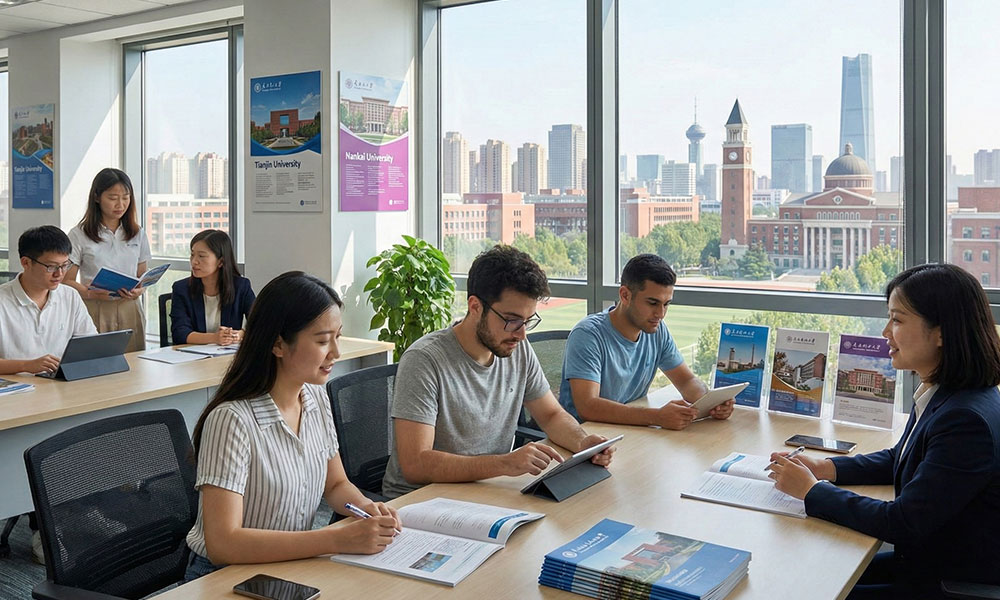
This might sound simple, but study in Tianjin universities in 2025 is all about preparation-language skills, decent academics, and paperwork on time. Most of them operate on a centralized online system, often via websites like their own or generally used ones such as CUCAS for the whole of China, though deadlines vary between April and June for fall semesters.
1. Tianjin University
Look at Tianjin University, for example, the flagship of the city. Founded in 1895 as Peiyang University, China’s first school of advanced studies in technology, this university requires students to have a high school diploma for undergraduate programs and to have proof of language proficiency. For Chinese-taught programs, it’s an HSK Level 5 score of at least 180; for the English ones, it’s IELTS 6.0 or TOEFL 80. Candidates under 25 are asked to scan in their passport and transcripts with a study plan-all to be uploaded before May 31. Review at TJU stresses capability rather than strict, rote scores, combining academic credentials with interview performance.
2. Nankai University
The second powerhouse to study in Tianjin Universities, Nankai University, mirrors this but introduces variation for the economics and math programs: teacher letters of recommendation carry weight and will be especially considered for scholarships. Undergrads need the same HSK baseline, while master’s hopefuls-less than 35 years old-submit transcripts for their bachelor’s degree, along with a 1,000-word research proposal.
3. Hebei University of Technology
Hebei University of Technology, is one of the best options to study in Tianjin Universities with its applied focus on materials science. HSK 4 for entry-level Chinese programs, while English options require TOEFL equivalents across the board. Minors under 18? You’ll need a notarized guardian letter from a Tianjin resident.
4. Tianjin University of Science and Technology
Tianjin University of Science and Technology, strong in food engineering, asks for a pre-arrival deposit of 7,000 RMB against visa docs, refundable against first-semester fees if you show up. Deadlines are slightly flexible—March for CSC scholarships, June for self-funded—but miss them, and you’re out.
Pro tip: Notarizations take time to process, so begin that early; international courier services may lag. Once accepted, expect an e-JW202 visa form by July, followed by in-person registration where originals get scrutinized. Failure here means a knockout, so double-check everything. For 2025, expect more virtual interviews to accommodate global applicants, a nod to hybrid learning trends.
Overall, Tianjin universities admission requirements reward proactive types: get your documents together, ace the language test, and be prepared to make a case for why a Tianjin degree will help you reach your goals. It is less about perfection and more about fit; study in Tianjin universities value students who will contribute to their innovative ecosystems. Diving into detail, let’s highlight a few to provide an example of variety.
5. Tianjin Medical University
Tianjin Medical University requires HSK 4 for clinical tracks for health sciences enthusiasts but does not require it for English MBBS programs, instead emphasizing biology-heavy high school credits. Tianjin Normal University is tailored for education majors and requires teaching potential through a short video demonstration for pedagogy applicants. Each has criteria matched to strengths, but the overriding principle behind them is accessibility: no SAT/ACT requirements-just holistic reviews that level the playing field for different backgrounds.

Popular Majors in Tianjin
Engineering and technology are where Tianjin’s academic heartbeat is strongest, reflecting the industrial face of the city and its striving for smart manufacturing. The most popular majors to study in Tianjin universities include:
1. TJU programs
At TJU, chemical engineering comes first, which is not surprising when considering that it has world-class labs and tight connections with the biggest petrochemical companies in the Binhai New Area. Students here do not just do complex formulas but work on sustainable material projects funded by national funds and frequently get an internship in firms such as Sinopec.
2. Nankai University Programs
Nankai University of Tianjin offers finance and pure math, whereby undergraduates study market models based on real data from the stock exchange nearby. It is hands-on, with case studies on investments in the Belt and Road, preparing graduands for global banks.
3. Hebei University of Technology Programs
The Hebei University of Technology attracts large numbers in urban planning for its theoretical and field combinations: mapping sustainable districts along the Haihe, working out flood risks with GIS tools, is a very hot topic after the 2023 rains.
4. TUST programs
TUST does exceptionally well in bioengineering, putting together food science and biotech to dream up lab-grown proteins created in facilities that double as industry incubators. Such majors are not in a silo; interdisciplinary vibes run quite deep, from TJU’s architecture that integrates AI developing virtual cityscapes, where coders and designers collaborate.
Why the buzz? Employability. Chemical engineering graduates from TJU boast 95% placement rates, often in R&D hubs. Finance at Nankai feeds into fintech startups, while planning alums shape Tianjin’s ecozones. In 2025, look for spikes in new energy majors–think renewables at TJU’s School of Environmental Science–paralleling China’s carbon-neutral goals. And there are plenty of English-taught options to make entry easier for internationals, though Chinese immersion can add cultural depth. The rigorous lectures punctuated by hackathons or field trips to the Tianjin Binhai Aircraft Industries park. Not abstract learning–forging tools for tomorrow’s challenge: green tech to urban resilience.
5. Other programs
Beyond the big three of engineering, business, and sciences are some niche picks to study in Tianjin universities that tend to one’s passion: precision instruments at TJU or tourism management at Nankai. A friend who went to Ocean University of China, with ties in Tianjin, majored in marine science and spent summers surveying Bohai Gulf ecosystems. Such is the popularity due to relevance: majors aligned with local industries ensured scholarships and jobs. By 2025, even as classes on AI ethics pop up, Tianjin’s lineup feels future-proof: an invitation to not just study trends but to steer them.
Tianjin Universities Scholarships
Funding for study in Tianjin universities adventure just got easier, thanks to a layered scholarship ecosystem designed to lure top global talent. The Tianjin Government Scholarship is a one-year renewable gem that doles out up to 20,000 RMB for tuition and 800 RMB insurance, perfect for self-funders who hope to extend their time in the city. You apply via university portals by May 31, 2025; it’s merit-based. TJU’s International Student Scholarship tiers it a bit further: Type A covers 20,000 RMB tuition waiver plus 1,400 RMB monthly stipend for high-achievers, while Type D grants partial-fee-paying students a pretty solid deal. Nankai similarly runs its version, except with the addition of living allowances for master’s in economics.
The best one to study in Tianjin universities? Chinese Government Scholarship of CSC at TJU, fully funded for 2025-2026, tuition, dorms, 3,000 RMB monthly for Masters, and 3,500 RMB for PhD, plus insurance. Deadline hits on February 5 via CSC’s site, agency code 10056, pre-admission letters and two recs needed. TUST has TGS variants for bio majors that waive 16,000 RMB undergrad fees. Hebei University of Technology sweetens the deal with enterprise-backed awards, including 10,000 RMB to materials science innovators.
These aren’t handouts; they’re investments. Recipients often join research teams, boosting resumes. One Pakistani engineering student we chatted with snagged TJU’s CSC last year-full ride, plus a mentorship that led to a Huawei internship. For 2025, expect more spots in emerging fields like AI, with virtual apps streamlining access. Tips? Tailor your study plan to university priorities-sustainability at TJU, finance at Nankai-and apply early. Renewals hinge on GPAs above 3.0, so consistency pays. With more than 1,000 awards citywide, Tianjin’s scholarships democratize elite education, turning financial hurdles into launchpads.
Tianjin Universities Tuition Fees
Tianjin universities tuition fees stay refreshingly anchored to the ground, especially compared to Western peers, so you can keep your mind on studies instead of spreadsheets. TJU sets the benchmark: undergrads pay 16,600-26,000 RMB yearly (about 2,300-3,600 USD), peaking at 26,000 for the five-year track in architecture. In English, chemical engineering? Still 20,000 RMB-a steal for its labs. Masters soar to 24,900-39,000 RMB (3,500-5,500 USD) with PhDs at 32,200-39,000. Nankai’s bachelor’s in finance comes in at 20,000 RMB, while its math PhD goes up to 30,000-value-packed, given this alumni network.
TUST keeps it lighter: 16,000 RMB for undergraduate food science, 24,000 for masters. Materials engineering at Hebei University of Technology? 18,000 RMB bachelor’s, scaling to 28,000 for graduate work. Medical tracks at Tianjin Medical University nudge higher-25,000-37,000 RMB for MBBS-but cover clinical rotations. Add-ons like 420 RMB apps and 800 RMB insurance are one-offs, with dorms at 15-60 RMB/day (200-800 USD per year). Self-fund? Wire first-year fees post-acceptance; scholarships in china offset most.
For 2025, tuition fees to study in china and Tianjin Universities remains the same with inflation controls, but English programs could increase up to 5% due to additional course offerings. This is realistic pricing-quality without extravagance-leaving room for adventures in Tianjin. Quickly doing the math, 20,000 RMB tuition plus 5,000 for dorms totals less than $4,000 per year, which beats many state schools overseas, especially with post-graduation payoffs such as 90% employment in the tech sectors.

Student Living Cost in Tianjin
Living in Tianjin as a student is not expensive; monthly living expenses for frugal students are around 3,000-5,000 RMB (420-700 USD), much cheaper than Shanghai’s frenzy and with many similar perks. Dorms really anchor affordability: TJU’s doubles run 30 RMB/day (about 900 RMB/month) and include Wi-Fi and laundry. Off-campus? Find one-bedroom apartments near Nankai running 2,000-3,000 RMB in places that are a bit quieter, like Hexi District, with utilities adding 200 RMB for AC and heat.
Food is a highlight: street eats like roujiamo (a meat burger) for 10 RMB fuels the 1,000 RMB grocery month of rice, veggies, and campus cafeterias with meals for 15 RMB. Eating out while study in Tianjin universities: Mid-range restaurants near Haihe: two can dine for 100-200 RMB; Western chains like Starbucks: 30 RMB latte. Transportation is easy: Metro monthly pass 100 RMB covers six lines; Taxis start at 10 RMB/km via Didi app. Bikes: Shared ones are 1 RMB/30 minutes.
The rest is miscellany: gym memberships, 200 RMB; mobile plans, 50 RMB; weekend trips to Beijing, 300 RMB, rail round-trip 150 RMB. Total? 4,000 RMB sustains most, per expat forums—leaving wiggle room for books, 500 RMB/semester, or events. Families bump that to 8,000 RMB, but students thrive solo. In 2025, inflation in check, it’s stable; shop the wet markets for deals, and you’re golden. The rhythm of Tianjin is affordable yet vibrant, letting you invest in experiences, not just survival.
Conclusion
In 2025, study in Tianjin universities stands among the best-kept secrets in China for international students. World-class engineering and research universities; Tianjin universities tuition fees are often below US$4,000 per year; good scholarships; and living costs that can allow you to save rather than scrape by. Just 30 minutes from Beijing but far more laid-back and affordable, the city offers cutting-edge labs, English-taught programs, and a lively riverside lifestyle. Whether you aim for chemical engineering at TJU or finance at Nankai, or anything related to sustainable tech somewhere in between, Tianjin delivers elite education without elite pricing. Apply early, secure your scholarship, and step into a new generation building tomorrow’s China. For additional information about Tianjin universities admission requirements contact us.
FAQs:
1. Do universities in Tianjin require the Gaokao for international students?
No. International applicants are totally exempt from the Chinese Gaokao. Admission is completely based on your high-school diploma, or bachelor’s degree for graduate programs, with language scores, HSK or IELTS/TOEFL, and supporting documents. Foreign students are evaluated for admission to Tianjin universities through their own international admissions systems.
2. Is it possible to study in English in Tianjin, or is Chinese compulsory?
Most of the flagship programs are entirely in English, especially at Tianjin University, such as chemical engineering, architecture, and MBA programs, and Nankai University-International Economics and IMBA. Tianjin Medical University offers a complete English-taught MBBS. You will need Chinese proficiency (HSK) if your program is taught in Chinese or if you want some specific scholarships.
3. When should I apply for the fall 2025 intake and scholarships?
CSC: December 2024 – February 2025, Tianjin Government & University scholarships: March–early May 2025, Self-funded regular admission: until June 2025. Some schools close at the end of May. Therefore, it is better to start preparation for your documents in November–December 2024 to be one step ahead.


No comment