
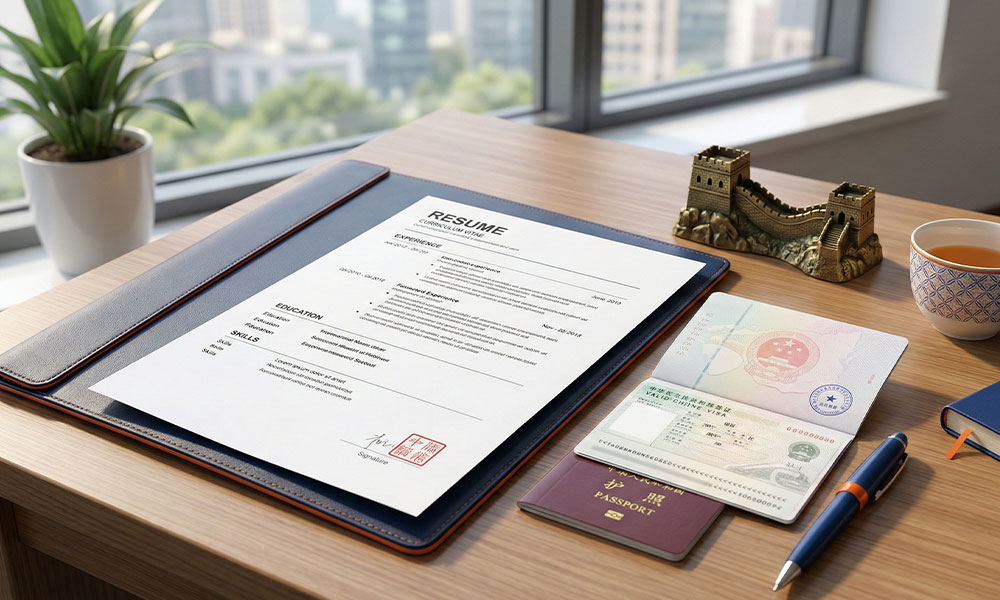
Many Iranian students are applying to study in China. Therefore, many questions arise about the international resume for applying to China. With its prestigious universities, outstanding educational and research facilities, and generous scholarships, China has become one of the most popular study destinations not only for Iranians but also for students worldwide.
A resume for China is one of the most influential factors in gaining admission to universities in the country. It is your professional introduction to university admissions officers and scholarship committees. A good resume should showcase your academic path, skills, and potential fit for Chinese programs while respecting the university’s expectations. In this article from the Admission Institute series, we will explore how to write a resume for Chinese universities.
International resume for applying to China, and how is it different?
An international resume for a Chinese application (often called a CV in academic circles) is a concise yet comprehensive document (usually 1-2 pages) that describes your educational background, experience, skills, and achievements for admission to Chinese higher education or for scholarships. This document is your academic and professional profile for university programs, the Chinese Government Scholarship (CSC ) application, or pre-admission contact with professors.
A resume for China differs in key ways from a resume for Western universities. Western resumes are highly personalized, omitting photos and personal details such as age or marital status. CVs for Western universities focus only on relevant experience. According to China Admissions guidelinesand university websites (such as Beiyang University and Beijing Normal University), applicants’ resumes should include the following:
- Professional passport photo (head and shoulders, white background, formal wear)
- Basic personal information (nationality, date of birth, gender)
- Complete educational history, sometimes from high school or even elementary school, for undergraduate admission
- All academic and professional experiences, even if not directly related to your intended major. Chinese universities value well-rounded individuals who demonstrate discipline and breadth.
Standard English language proficiency is required for all international applicants, although some programs at Chinese universities are offered bilingually (Chinese/English). Having a Chinese language qualification can also increase your chances of gaining admission and receiving scholarships.
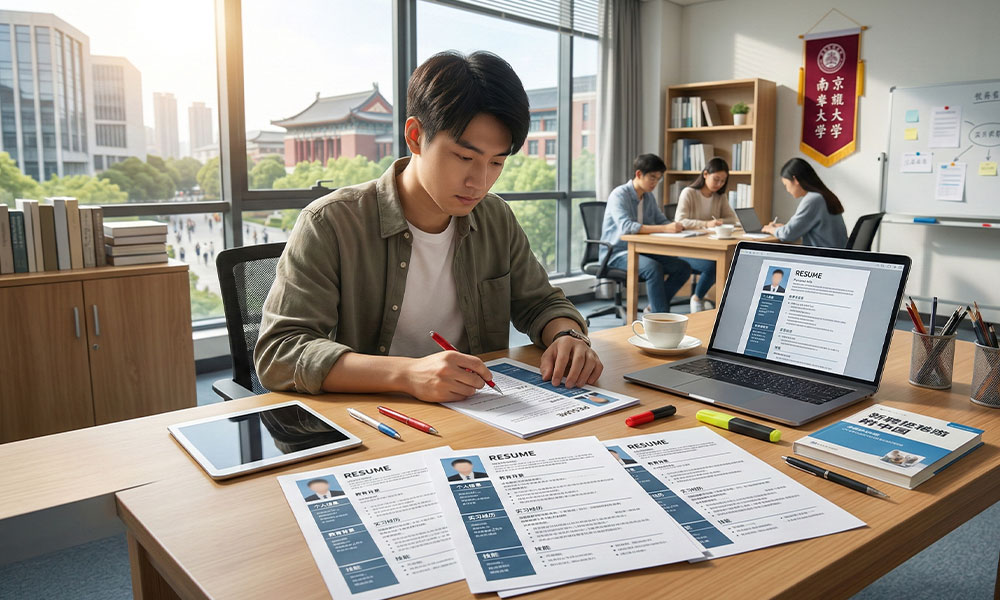
Standard resume structure for a university in China
chronological structure that prioritizes education and academic achievements. Based on official sources from institutions such as Beihang University, SUSTECH, and Renmin University, they consistently list the following sections for an international resume for applying to China:
- Personal/Basic Information (with photo)
- Educational background
- Research experience/projects/publications (especially for bachelor’s/master’s/doctoral)
- Work experience/internship
- Awards and honors
- Skills and languages
- activities /volunteer work
- References (optional but recommended for CSC )
CSC graduate programs or university-specific applications, add a short section such as (objective) or (research direction) to align with the field of study. The entire document should be written in each section from newest to oldest. This structure also aligns with CSC expectations that the resume supports the study plan with your research proposal. Many universities explicitly request a resume that includes continuous analytical and work experience since undergraduate studies. (Bhiyang University Guidelines)
How to write each section of your resume professionally
Your resume should be written in English (unless the university specifically requests a Chinese version). Use a formal, precise tone without exaggeration. Use strong verbs in your sentences. Keep each sentence short (1-2 lines maximum) and include numbers, percentages, or tangible results where required. Your resume should be no longer than one to two pages. Here’s a step-by-step guide to writing an international resume for China:
1. Personal information
This section should be centered or left-aligned at the top. Place the photo in the top-right or top-left corner. This information should include your full name, nationality, date of birth, gender, professional contact number, professional email, WeChat ID, and current address or LinkedIn. Use a recent professional photo. Avoid selfies and casual photos. For example:
Ali Mohammadi
Iranian National Male| Date of Birth: 27 December 1998
Phone: +989123456789 Email: [email protected]
WeChat ID: Alimohammadi-IR| LinkedInlinkedin.com/in/alimohamadi-eng.
2. Career goal or summary ( Objective/career objective/Research Intent )
This section is short (3-5 lines) and is written just below your personal information. In this section, you should state your purpose for studying in China. The purpose section is particularly important for both CSC and professor-based admissions. In this section, you should explain the intended field and degree, the university or type of program, specific research interests (preferably related to the work of the target professor or university), and how you are going to contribute to Iran-China cooperation or scientific advancement.
For example (Electrical Engineering – Master’s degree applicant)
Objective
Highly motivated Iranian electrical engineer seeking a Master’s degree in Power Systems under the Chinese Government Scholarship (CSC) at Xi’an Jiao Tong University. My research interest focuses on renewable energy integration and smart grid optimization using AI techniques. I aim to contribute to Sino-Iranian cooperation in sustainable energy technologies through research and practical application.
Common mistake: Using clichés like “I want to study in China because it’s a good country.”
3. Educational background
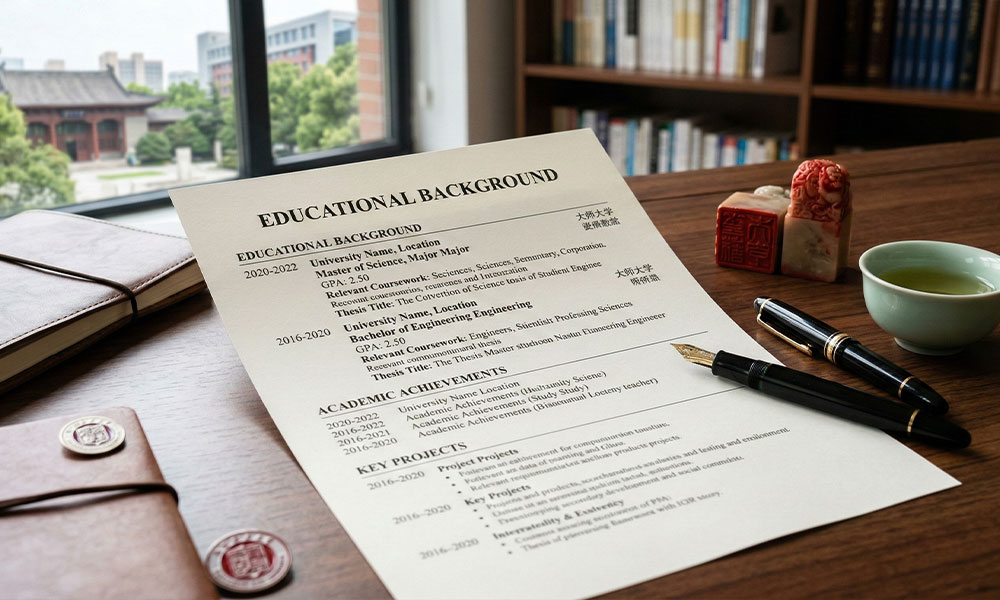
List your educational background in reverse order (following the instructions above). For each item, include the name of the university and location, the level of study, the major, the dates, the GPA, and key points, such as the title of the thesis and relevant coursework. Iranian applicants should note this if they earned their degree from a reputable university, such as the University of Tehran. Include any exchange programs or online certificates related to China in this section as well.
Master of Science in Computer Engineering (in progress)
University of Tehran, Tehran, Iran
Sep 2023- Expected Jun 2026
GPA: 17.6 (Equivalent to 3.8/4.0)
Thesis: Deep Learning-Based Fault Detection in Industrial IoT Networks
Advisor: Prof. Reza Farahani
Bachelor of Science in Computer Engineering
Sharif University of Technology, Tehran, Iran
Sep 2019 – Jul 2023
GPA: 16.9/20 (Top 1% of cohort)
Relevant Coursework: Data Structure, Algorithm, Machine Learning, Computer Network, Database Systems
Note: If the GPA has been converted to the 4.0 system, be sure to write Equivalent to
3. Research experience/projects
This section of your international resume is crucial for applying to undergraduate programs in China. Describe 2-4 key projects, including role, duration, technologies used, results, and impact. Use noun verbs such as (developed), (analyzed), (published), etc. For scholarship applications, link the projects to potential research collaborations with China (such as the Belt and Road Initiative).
Research Project: Predictive Maintenance System for Wind Turbines Using Machine Learning
Jan 2024- Present
- Designed and implemented an LSTM neural network model, achieving 92% accuracy in fault prediction
- Collected and preprocessed a dataset of 150,000 sensor readings
- Reduced system downtime by 35%in case studies
- Preparing manuscript for submitting to IEEE Transactions on Sustainable Energy
Publication: Mohammadi A.et al. AI-driven Energy Optimization in Microgrids”. 5th International Conference on Renewable Energy, Tehran, 2025 (Accepted).
If you don’t have an essay, write course projects, theses, or lab work with technical details.
4. Work experience/internship
Even short internships are important. For each, list the position, organization, location, dates, and 3-5 accomplishments. If your business is limited, include teaching assistant roles or freelance work in this section.
Teaching Assistant – Power Electronics Course
University of Tehran
Sep 2024 – Present
- Conducted weekly tutorial sessions for 65 undergraduate students
- Prepared and graded assignments, improving the average class score by 12%
- Developed supplementary MATLAB simulations for circuit analysis
Intern – Renewable Energy Department
MAPNA Group, Karaj, Iran
June – August 2022
- Assisted in the design review of a 50 MW solar farm project
- Created technical documentation, reducing review time by 25%
5. Awards and Honors
List awards and honors received, including the date and issuing institution. Mention scholarships, victories in international competitions, or Olympiads, etc.
- National Elite Foundation Scholarship, Iran (2023 – 2025)
- 1 st Place – National Student Robotics Competition, Tehran (2022)
- Dean’s List (Top 5%), Sharif University of Technology (2020-2023)
6. Skill Languages I see
Technical skills (e.g., Python, MATLAB, AutoCAD), soft skills (leadership, teamwork), languages (Persian: native, English: IELTS 7.5, Chinese: HSK 3–180), and software. Or mention tools related to the field in this section.
Technical Skills: Python (Advanced), MATLAB & Simulink (Expert), ANSYS, SolidWorks, TensorFlow
Languages: Persian (Native), English (IELTS 7.5), Chinese (HSK 4 – 210 score – intermediate)
Other: Microsoft Office (advanced), LaTeX, Git
8. Activity Extracurricular Activities/Volunteer Work
Show your well-rounded personality in this section of your international resume for applying to China. You can mention volunteer work, sports, cultural clubs, or participation in the Iran-China Friendship Society. Chinese universities value well-rounded students for admission.
Volunteer Translator – Iran-China Friendship Association (2024)
- Translated technical documents for bilateral energy workshops (English – Persian)
- Member – University Entrepreneurship Club (2021-2023)
- Organized 3 startup pitch events with 200+ participants
9. References
In this section, with permission from the professors, introduce a few of your professors with contact details. Usually, you should introduce 2-3 professors. For example:
Prof. Mohammad Karimi
Professor of Electrical Engineering, University of Tehran
Email: [email protected] | Phone: +98 9123456789
(Available upon request – or write directly)
10. Final Notes for All Sections
Have your resume proofread by a native English speaker or someone who has experience applying to China. Use Arial or Times New Roman font size 11 or 12. Create a PDF version of the existing file and name the file professionally :
AliMohammadi_CV_CSC_XJTU_2026.pdf
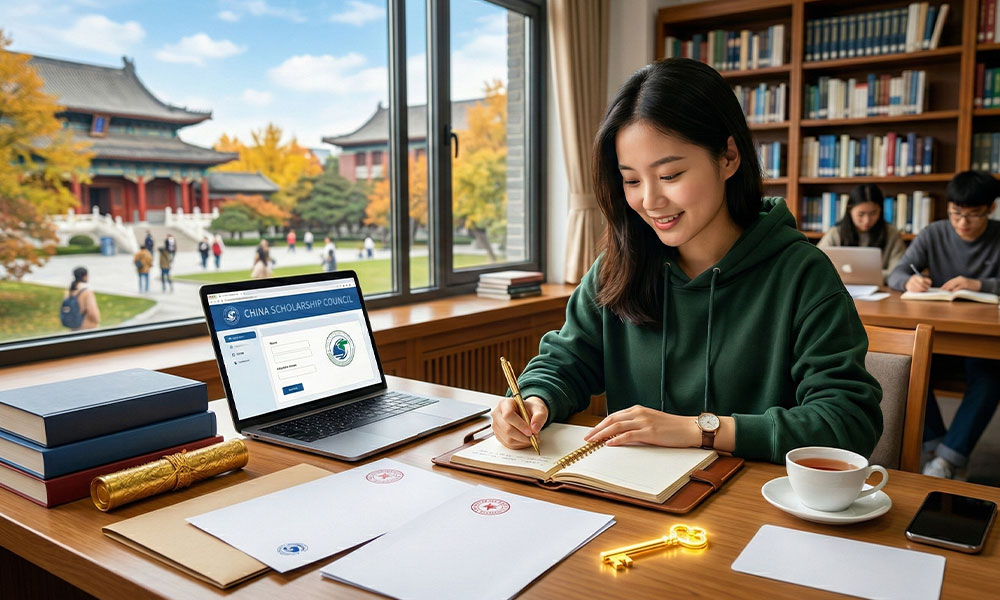
Golden tips for getting a China Scholarship ( CSC )
Obtaining a CSC scholarship (full tuition and a stipend of about 3,500 yuan per month) requires a strong academic record. Below, we examine the strategies that successful students have used to obtain this scholarship:
- Full alignment with the program: Research the target university and professor. Mention specific labs or projects in the resume objective. Contact professors and attach a resume for an acceptance letter. This will increase your chances of getting a CSC Type B scholarship.
- Emphasize research potential: For a master’s/doctoral degree, dedicate space to articles, conference presentations, or ongoing projects. Even a co-authored article in a reputable journal can greatly increase your chances of acceptance.
- Highlight language skills and adaptability: Strong English language skills (IELTS/TOEFL) are essential for English-language programs. Basic Chinese language skills will demonstrate your commitment and facilitate daily interactions. As an Iranian applicant, mention any Persian-Chinese cultural exchange experiences.
- Quantify achievements: Numbers are much more influential than mere mentions of quality. For example, instead of writing (good student), write (ranked in the top 5% of a group of 120 with a GPA of 18.20).
- Educational Break: Explain any educational break (e.g., military service) in a positive light and focus on the skills acquired.
- Submit early and follow up: Due to high competition, avoid submitting international documents and resumes at the last minute for Apply China. Submitting early and combining your resume with an attractive study plan can increase your chances of being accepted.
Common mistakes in Chinese application resumes.
Admissions committees of prestigious Chinese universities such as Tsinghua Universityof China, Peking UniversityChina, Fudan UniversityShanghai, etc., and the China Scholarship Council review hundreds of applications every year. Your resume is the first professional document they see and often makes the initial decision on admission within seconds. One small mistake can lead to the rejection of your entire application. Here are some common mistakes in international resumes for applying to China:
1. Not using the right photo
In the Chinese university admissions culture, a photo is an essential part of a resume. Without a photo, a resume is considered incomplete. Selfies, informal photos, photos with sunglasses, or photos that are older than 6 months (more than 6 months old) will result in rejection. The photo should be on a white background, in formal attire, unfiltered, and natural.
2. History Inconsistencies, errors, or unexplained gaps
CSC specifically looks for a complete resume from high school onwards. Any gap in education (even 3-6 months) without an explanation (e.g., military service, illness, internship) is considered suspicious of lying or a lack of commitment.
3. Description General and without quantitative achievements
It’s not enough to write sentences like (I was a hard-working student) or (I participated in a project). Admissions committees are looking for proof. Always include percentages, results, or impact in the text.
4. Resume that is too long (more than 2-3 pages) or too cluttered and unstructured
Use a maximum of 2 pages with 11-12 Arial/Calibri font, 1.5 line spacing, bold headings, and clear separators.
5. Spelling, grammar, or punctuation errors
Even a small mistake shows carelessness and a lack of professionalism. Such mistakes, especially in English-speaking fields, call into question your language proficiency. Check your resume at least 2 times before sending it. Use tools like Grammarly. A review by an English-speaking person or someone with experience applying to China can also be effective.
6. Minimalist Western Style
Chinese universities want a complete picture of you (including age, gender, nationality, and all the details). Omitting experiences will make them think you are hiding something. Write everything down, and justify unrelated business convincingly.
7. Fake or exaggerated information
International resume review committees for Apply China check the documents. Lying on a resume is equivalent to a lifetime of rejection. For example, claiming an article in a Q1 journal without a real DOI can be considered a lie. Write only what can be proven.
8. Mismatch with specific program/university
Creating a generic resume and sending it to different universities will greatly reduce your chances. Include the name of the university, professor, or specific project in the Objective or Research Experience.
9. Format Inappropriate file extensions
Using Word instead of PDF and using an unprofessional file name will reduce the chances of acceptance, and the Word file may crash on Chinese systems. Save the resume as a PDF with a professional name.
10. Not mentioning WeChat ID or professional email
Professors and admissions committees mainly use WeChat to communicate. Emails with strange, old-fashioned names will look informal. Be sure to include your WeChat ID and university email.
11. Use of artificial intelligence
From 2024-2025, many universities and CSC admissions committees will use AI recognition tools. Resumes that AI completely mines, such as ChatGPT or similar tools, tend to have a mechanical tone, overly structured content, and lack personal depth. Committees will quickly notice this because they have reviewed thousands of similar resumes.
If you use an international resume to apply to China, not only will your application be rejected, but you may also be blocked. Write your own resume, or at most, use AI only for grammar check or structure suggestions.
12. Ignoring the check University List
Some universities have specific formats or mandatory sections (e.g., a separate Research Proposal). Ignoring these can lead to rejection of your international resume for Apply China. Always check the university portal and CSC website and follow the instructions exactly.
Suitable resume format for applying to China
The appropriate format for an international resume for a China application is an A4-sized page, PDF format, with 1-inch margins in all directions. Use Arial or Times New Roman font size 11-12 and 14 bold for headings. Some universities prefer a specific hood format; be sure to check before applying.
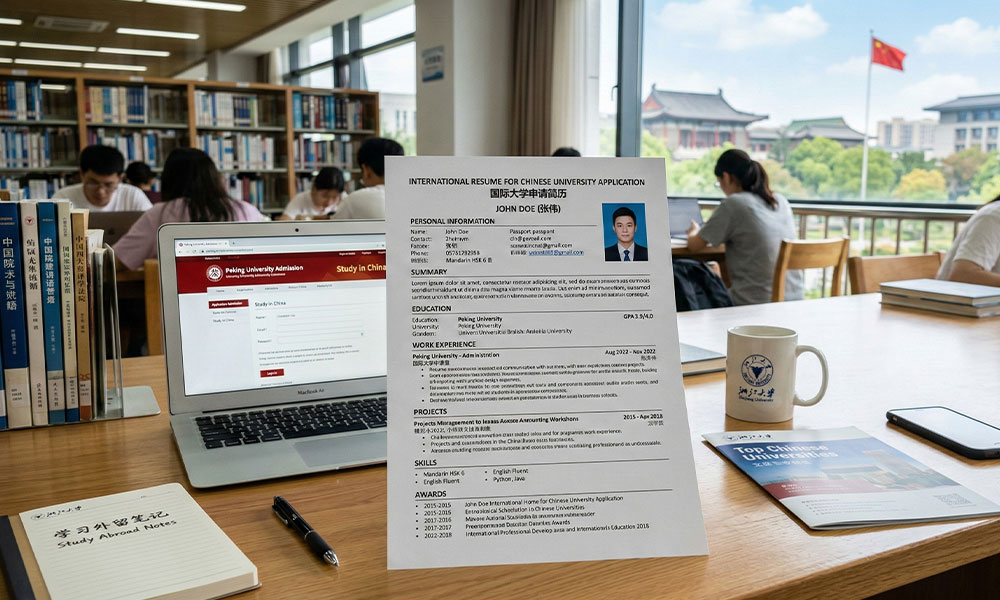
International resume sample for applying to China
Below, we provide a sample international resume for Apply China that you can copy and paste your personal information into if needed.
YOUR FULL NAME
[Phone Number] | [Email Address] | [WeChat/LinkedIn Profile] | [Address]
[Date of Birth] | [Nationality] | [Passport Number]
PERSONAL STATEMENT / OBJECTIVE
[A 3-4 sentence summary of your academic background, research interests, and why you wish to study in China (eg, “Motivated Engineering graduate with research focus on renewable energy, seeking to pursue a Master’s at [University Name] to contribute to Sino-foreign scientific collaboration.”).]
EDUCATION
[Master of Science in Field] | [University Name], [City, Country] | [Month, Year – Month, Year]
Thesis: ” [Title of your thesis].”
Key Modules: [Relevant Module 1], [Relevant Module 2]
GPA: [ X. XX/X. XX] (Optional: Rank [X/XX])
[Bachelor of Science in Field] | [University Name], [City, Country] | [Month, Year – Month, Year]
GPA: [X. XX/X. XX]
Relevant Projects: ” [Title of major project or final year project].”
RESEARCH EXPERIENCE
[Position, eg, Research Assistant] | [Name of Laboratory/Department] | [dates]
[Action verb] + [Task] + [Result/Skill gained] (eg, “Assisted Professor X in collecting data on…”).
[Describe research methodologies, tools, or techniques used].
WORKING EXPERIENCE / INTERNSHIPS
[Job Title] | [Company Name], [City, Country] | [dates]
[Brief description of responsibility].
[Key accomplishment or skill developed].
AWARDS AND HONORS
[Award Name, Awarding Institution] | [Year]
[Scholarship Name] | [Year]
PUBLICATIONS (If Applicable)
[Author Names], ” [Title of Paper],” [Journal/Conference Name, Year].
SKILLS AND LANGUAGES
Languages: [Native Language], English ([Level, eg, Proficient]), Chinese ([HSK Level/Level of fluency]).
Technical Skills: [Software, Programming Languages, Lab Techniques, eg, Python, MATLAB, SPSS, HPLC].
EXTRACURRICULAR ACTIVITIES / VOLUNTEERING
[Member/Leader], [Club/Organization Name] | [dates]
[Brief description of activity, highlighting leadership or cultural exchange].
Czech Final list before submitting a resume
Check your resume for the following before submitting:
- Is it customized for a specific program/university?
- Is the professional photo included and appropriate?
- All dates accurate and Chorological without gaps (academic chat)?
- Are the achievements quantified, and strong action verbs used?
- Reviewed by at least 2 people?
- PDF file format and file name saved appropriately?
- the CSC or university format, if applicable?
- Are the references coordinated, and have the details been confirmed?
- Is it consistent with the study plan/research proposal?
Conclusion
Creating an international resume for China requires attention to detail, cultural awareness, and a true reflection of your strengths. For Iranian students, a resume for China is more than just an administrative document; it is a symbol of your ambition to connect nations through education and innovation.
Follow the structure and tips provided in this article, which are directly taken from the official guidelines of Chinese universities, and create a professional resume. If you need help writing your professional resume, we are here to help you with hundreds of successful academic immigration cases. Contact us for more information and expert advice.
1. Does an international resume for applying to China necessarily require a photo?
Yes, a professional passport photo (white background, formal wear, recent) is required. A resume without a photo is considered incomplete. Selfies or informal photos will result in the rejection of the resume.
2. What is the main difference between a Chinese resume and a Western university resume?
The Chinese resume is more complete, including a photo, personal information, a full academic history, etc. Unlike Western admissions committees, which favor a minimal approach and lack personal details, Chinese admissions committees value a comprehensive personal image.
3. Why shouldn’t we use artificial intelligence to write an international resume for Apply China?
Universities and the CSC admissions committee use AI recognition tools. AI often has a mechanical tone, repetitive sentences, and a similar structure. A resume needs personal details. A resume should be authentic and edited by you to show your true personality.

No comment