
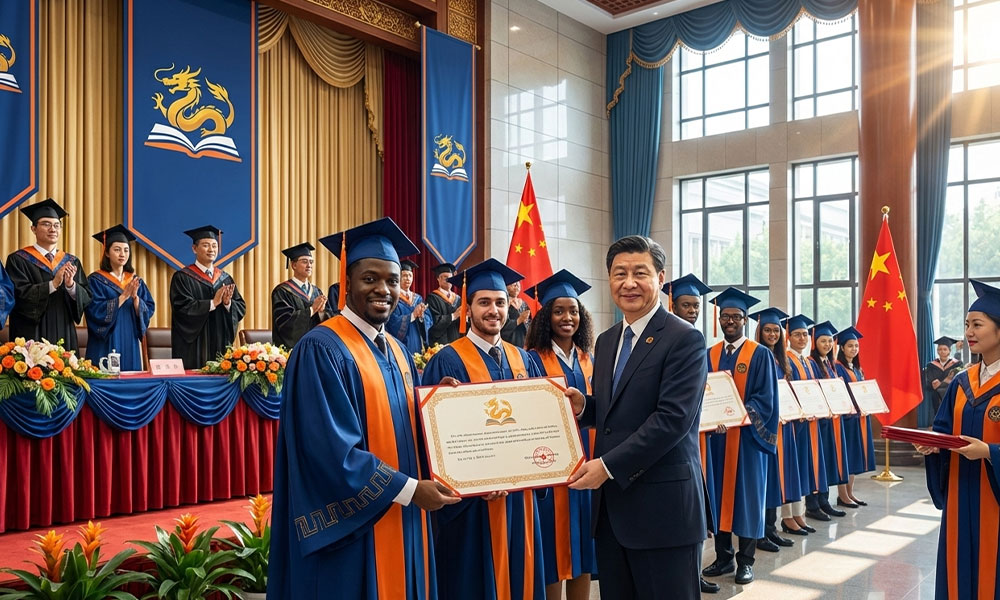
In an era where global education is more accessible yet fiercely competitive, the Chinese Government Scholarship (CSC) stands out as a beacon for ambitious international students seeking world-class higher education without the crushing financial burden. Launched by China’s Ministry of Education and administered by the China Scholarship Council (CSC), this flagship program has transformed the academic trajectories of thousands since its inception.
For 2026, the CSC Scholarship benefits continues to offer fully funded opportunities across undergraduate, master’s, and doctoral programs at over 280 prestigious Chinese universities. What makes the CSC Scholarship particularly compelling is its comprehensive coverage: it not only waives tuition fees but also provides free on-campus accommodation, a generous monthly stipend, and comprehensive medical insurance. As China solidifies its position as a global innovation hub—with institutions like Tsinghua University china and Peking University consistently ranking among the world’s top 20—the scholarship aligns perfectly with the nation’s “Belt and Road Initiative” and its push for international academic collaboration.
This article from the Admission Institute delves into every facet of the program, from eligibility and application steps to real-world benefits and comparisons with alternatives.

documents required for CSC scholarship: How to Get Admission to Chinese Universities
Securing admission to a Chinese university is the foundational step toward securing a CSC Scholarship benefits, especially for Type B applications (the direct university route). Unlike many Western systems, China’s admissions process emphasizes academic merit, research potential, and cultural adaptability. Start by identifying programs that match your profile—use platforms like CUCAS or the universities’ international offices for English-taught options.
1.documents required for CSC scholarship: Early Preparation
The key to success is early preparation. Most top universities, such as Fudan or Zhejiang, require a strong academic record (GPA of 3.0+), a compelling study plan, and, often, a pre-admission letter from a supervisor. For CSC hopefuls, contacting professors via email is crucial; a polite, tailored message that highlights your alignment with their research can yield an acceptance letter, boosting your application by 30-40% in competitive fields like AI or environmental science.
2. Language Proficiency
Language proficiency plays a pivotal role. For Chinese-medium programs, an HSK Level 4 or 5 is typically mandatory, while English-taught ones accept IELTS 6.0+ or equivalent. Universities also value extracurriculars—internships, publications, or volunteer work in China-related projects demonstrate commitment.
3. Online Application
The process unfolds in phases: online application via the university portal (often free or low-fee), document submission, and interviews (virtual or in-person). Deadlines for 2026 admissions generally fall between December 2025 and March 2026, depending on the institution. For instance, Tsinghua’s graduate programs close applications for early birds by mid-December.
Pro tip: Leverage bilateral agreements. Students from partner countries (e.g., via Pakistan’s HEC or EU Window) get priority. Once admitted, the university issues a JW201/JW202 form, essential for visa processing. With over 500,000 international students already in China, the system is streamlined but demands precision—missing a transcript notarization can derail your plans.

Monthly Stipend of CSC Chinese Government Scholarship
The “monthly salary,” as many call it, is the CSC Scholarship’s heartbeat, providing financial independence that lets scholars focus on studies rather than survival. For 2026, the stipend remains robust, calibrated to China’s cost of living while encouraging excellence.
- Undergraduates and general scholars: 2,500 RMB (about $350 USD) per month.
- Master’s students: 3,000 RMB (around $420 USD).
- Doctoral candidates and senior scholars: 3,500 RMB (roughly $490 USD).
This is disbursed directly to your campus account, tax-free, for 12 months a year during the program duration (typically 2-4 years, plus optional Chinese language prep). It’s designed to cover meals (1,000-1,500 RMB), personal expenses, and local transport, leaving room for savings or travel.
Beyond the stipend, full scholars enjoy tuition waivers (up to 40,000 RMB/year for PhDs) and accommodation subsidies (often free dorms worth 800-1,200 RMB/month). Comprehensive medical insurance (800 RMB/year) handles everything from routine checkups to emergencies, a godsend in a country with top-tier hospitals.
Chinese Government Scholarship Deadline 2026
Timing is everything for the 2026 CSC cycle, with deadlines staggered to accommodate global applicants. The program officially opens in late 2025, but specifics depend on your route.
- For Type A (Bilateral Program)—via Chinese embassies—applications typically close between January 10 and February 28, 2026. For example, the U.S. Embassy sets February 16 as the online cutoff, with interviews following. EU applicants face similar windows, often mid-February.
- Type B (University Program) offers more flexibility, with deadlines from November 2025 to April 2026. High-Level Postgraduate Programs at places like Chongqing University run until March 15, while some like Xiamen University extend to late March.
Key 2026 milestones:
- Applications open: November 1, 2025 (for most).
- Peak deadlines: February 8-28, 2026 (embassy routes).
- Results: July 2026.
- Enrollment: September 2026.
Bachelor’s seekers must now take the China Scholastic Competency Assessment (CSCA) by January 2026. Always check the CSC portal (campuschina.org) or your local embassy—delays happen, but proactive monitoring via WeChat groups or official Weibo ensures you don’t miss out. Late submissions? Rare exceptions for force majeure, but don’t count on them.
Steps to Apply for the Chinese Government Scholarship
Applying for the CSC Scholarship benefits is a structured yet rewarding marathon. Here’s the foolproof roadmap for 2026:
1. Research and Choose: Browse 279+ approved universities on the CSC site. Narrow by major—e.g., engineering at Harbin Institute of Technology. Verify English/Chinese options.
2. Prepare documents required for CSC scholarship: Gather essentials (detailed below). Notarize diplomas and transcripts; get two professor recommendations.
3. Online Registration: Create an account at studyinchina.csc.edu.cn. Select Program Category: Type A (embassy agency number) or Type B (university code, e.g., 10003 for Tsinghua).
4. Fill the Form: Upload passport, study plan (1,000+ words), and language proofs. For Type B, apply to the university first for pre-admission.
5. Submit and Track: Print and mail hard copies if required (some embassies skip this). Follow up via email.
6. Interviews and Offers: Expect video calls to test your motivation. Awards are announced via email.
7. Visa and Arrival: With the scholarship letter, apply for an X1 visa—orientation in September.
Success hinges on authenticity—tailor your study plan to China’s priorities, like green tech. Applicants can submit up to three forms (two Type A, one Type B), but quality trumps quantity.
Many successful applicants say the same thing: contacting professors before applying is what made the difference for them. They often mention that a simple email expressing interest in the professor’s research led to a positive response. Some even received pre-acceptance letters this way. According to them, this step matters more than grades or language scores in many cases.
Chances of Acceptance of Chinese Government Scholarship
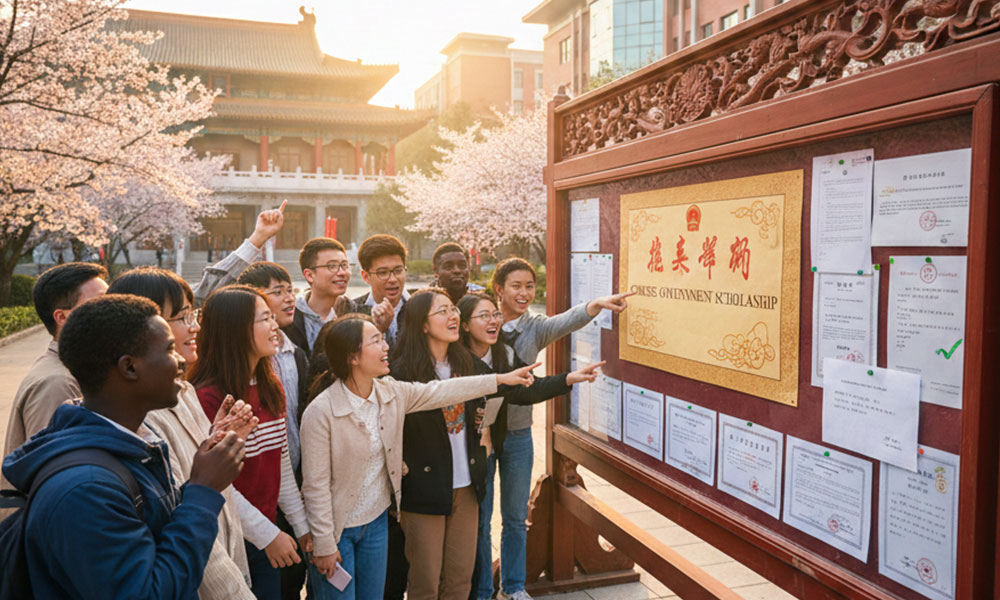
Is the CSC a long shot? Yes and no. With over 50,000 annual applicants for limited spots (around 10,000-15,000 awards), acceptance hovers at 15-25% overall—but your odds improve dramatically with strategy.
Factors boosting chances:
- Strong Academics: Top 10% in your cohort.
- Research Fit: Pre-admission letters from supervisors (50% of winners have them).
- Diversity: Underrepresented regions (Africa, Latin America) get quotas.
- Language: HSK 5+ for Chinese programs; flawless English essays.
Data from past cycles shows STEM fields (AI, biotech) at 30% acceptance for PhDs, while the arts hover at 10%. Women and those over 30 face no bias, but age caps apply (under 35 for masters).
Rejections often stem from weak study plans or mismatched universities. Tip: Apply to 2-3 unis in different tiers. With a solid profile—say, a published paper and volunteer experience—your chances hit 40%+. Thousands succeed yearly; persistence pays.
Language Certificate for Chinese Government Scholarship (HSK/IELTS)
Language barriers? The CSC has you covered, but proof is non-negotiable. For Chinese-taught programs (90% of offerings), HSK is king:
- HSK Level 4 (180+ score): Minimum for undergrads; Level 5 (180+) for grads.
- Prep tip: 6-12 months of study via apps like HelloChinese. English-taught programs (growing in popularity, especially at Tsinghua and SJTU) require:
- IELTS 6.0-6.5 or TOEFL 80-90.
- Alternatives: Duolingo or a university-issued English Medium Instruction letter (if prior studies were in English).
No certificate? Many unis offer one-year Chinese prep under CSC—free and immersive. For 2026, bachelor’s applicants need CSCA scores and language proofs.
Pro advice: Take tests early (HSK exams monthly). A strong score isn’t just a checkbox; it signals adaptability, tipping scales in interviews.
List of CSC-Approved Universities
The CSC partners with 279 universities, spanning every province. Here’s a curated selection of top-tier options (full list at campuschina.org):
- Beijing (Innovation Hub): Tsinghua University (Agency No. 10003), Peking University china (10001), Beihang University (10006).
- Shanghai (Global Finance): Fudan University of Shanghai (10246), Shanghai Jiao Tong University (10248), Tongji University (10247).
Other Powerhouses:
- Zhejiang University (10335, Hangzhou)
- University of Science and Technology of China (10358, Hefei)
- Xi’an Jiaotong University (10712)
- Wuhan University (10486)
- Sun Yat-sen University (10558, Guangzhou)
Specialized picks: Harbin Institute of Technology (for engineering), Sichuan University (medicine). No application fees at many, likeJiangsu University. Check agency numbers for Type B—vital for your form.
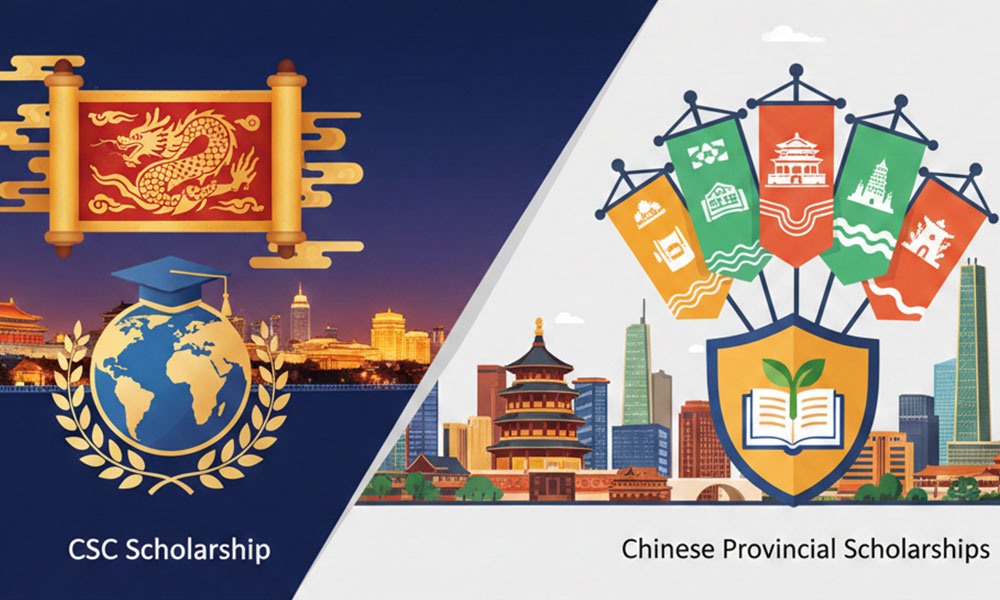
Comparison of CSC Scholarship and Chinese Provincial Scholarships
While CSC is the gold standard, provincial scholarships offer viable backups.
| Aspect | CSC Scholarship | Provincial Scholarships |
| Coverage | Full: Tuition, dorm, 2.500-3.500 RMB stipend, insurance | Partial: often tuition + partial stipend (1.000-3.000 RMB); dorm sometimes extra |
| Eligibiliy | Nationwide, all nationalities | Province-specific; easier for locals or targeted fields |
| Competition | High (15-25% acceptance) | Medium (30-50%); less global applicants |
| Duration | Full program + language year | Similar, but shorter options |
| Application | Centralized via CSC portal | Direct to province/university; simpler docs |
| Perks | National prestige, networking | Local integration, easier extensions |
Last updated: 2/16/2026
CSC edges out for comprehensive support, ideal for long-term stays. Provincials shine for flexibility—e.g., Beijing Scholarship covers 20,000 RMB/year but requires on-campus work. Many blend them: Win CSC for masters, provincial for PhD extension. For budget-conscious students, provincials reduce the risk of rejection by 20%.
Cost of Living for Students in China
With CSC’s stipend, China is a bargain. Monthly costs for a scholar average 2,000-4,000 RMB ($280-560 USD), well within the 3,000 RMB master-level payout.
Breakdown (2026 estimates, per Numbeo and student reports):
- Accommodation: Free dorm (shared, 4-6 beds) or 800 RMB subsidy for off-campus.
- Food: 1,000-1,500 RMB (street eats like dumplings at 10 RMB/meal; campus canteens are cheaper).
- Transport: 100-200 RMB (subway unlimited pass ~150 RMB).
- Utilities/Internet: 200 RMB (included in dorms).
- Misc (books, gym, outings): 500-800 RMB.
Tier 1 cities (Beijing/Shanghai): 3,500-5,000 RMB total—stipend covers 80%, so save or tutor. Tier 2 (Chengdu, Wuhan): 2,000-3,000 RMB, leaving surplus for Taobao shopping or Silk Road trips.
Hidden gems: Student discounts (50% on high-speed rail), free museum access. Compared to Europe (2x pricier), China’s efficiency—WeChat Pay, bike shares—keeps it affordable. Budget hack: Cook in dorm kitchens; join expat WeChat groups for deals.
Conclusion
In conclusion, the Chinese Government Scholarship 2026 remains a transformative gateway for international talent, blending rigorous academics with unparalleled financial security and cultural immersion. As deadlines approach or pass in early 2026—depending on your embassy or university route—this fully funded opportunity equips scholars with tuition waivers, monthly stipends, accommodation, and insurance to thrive in China’s dynamic universities.
Beyond degrees, it builds cross-cultural bridges, fosters innovation, and opens lifelong networks in a rising global power. For determined applicants who prepare meticulously, meet language requirements, and align with China’s priorities, CSC 2026 isn’t merely funding—it’s a launchpad toward personal and professional excellence in one of the world’s most vibrant academic landscapes. Contact us for additional information and expert advice.
1. What is the monthly stipend provided by the CSC Scholarship for 2026, and does it cover living expenses adequately?
The stipend varies by level: 2,500 RMB (~$350 USD) for undergraduates/general scholars, 3,000 RMB (~$420 USD) for master’s students, and 3,500 RMB (~$490 USD) for doctoral/senior scholars. Paid monthly and tax-free, it covers meals (typically 1,000–1,500 RMB), transport, and personal costs. In tier-2 cities like Chengdu or Xi’an, it often leaves surplus for savings or travel; in tier-1 cities like Beijing or Shanghai, it covers basics comfortably but may require budgeting or part-time work (with approval) for extras.
2. What are the key deadlines for applying to the CSC Scholarship in 2026?
Deadlines vary by application type and country. For Type A (Bilateral/Embassy route), most close between early February and late February 2026 (e.g., February 8 in some embassies, February 16 for the U.S., or February 15–25 for others). For Type B (University Program), they range from December 2025 to March/April 2026 (e.g., February 15 at Xiamen or Sun Yat-sen University, February 25 at Chongqing University). Always check the official CSC portal (campuschina.org) and your localembassy/university for exact dates, as they differ slightly.
3. What language certificates are required for the CSC Scholarship 2026?
For Chinese-taught programs, HSK certification is mandatory: Level 4 (minimum score of 180) for most master’s/doctoral programs, Level 3 for undergraduates and general scholars (some senior programs). English-taught programs require IELTS 6.0–6.5, TOEFL 80–90, or equivalent. If lacking proficiency, many universities offer a free one-year preparatory program in Chinese under the CSC. Bachelor’s applicants may also need the China Scholastic Competency Assessment (CSCA) score. Submit proofs early; strong scores significantly strengthen your application.
 2026: Conditions and Benefits)
No comment